
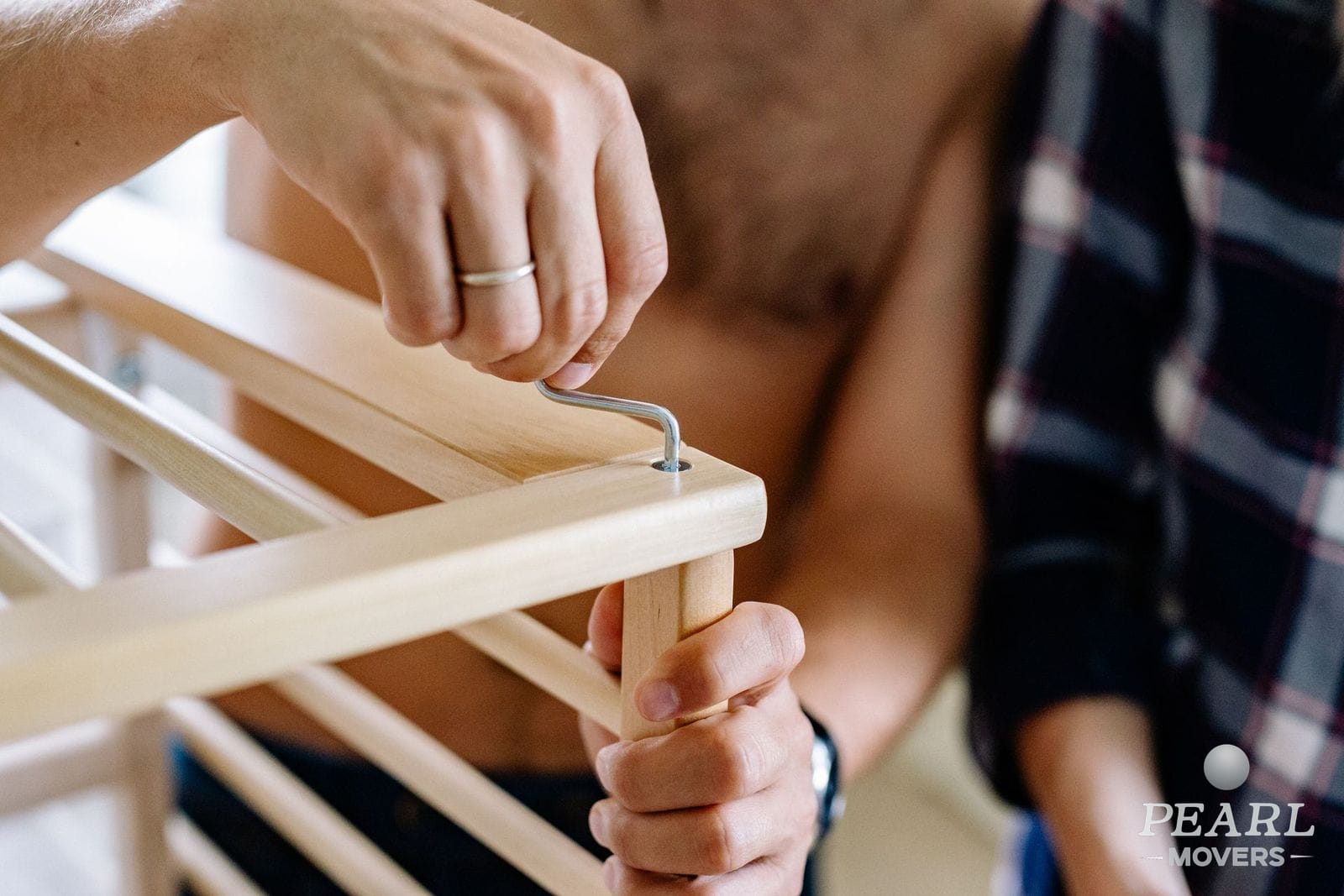
What crews commonly take apart
Some furniture cannot leave a room in one piece. A king bed frame will not turn the corner of most Portland stairwells, and a sectional that was assembled inside the living room usually has to leave the same way it arrived. Disassembly for these items is a normal part of residential moving, and crews carry the tools for it.
The usual list:
- Bed frames, including headboards and footboards. Slats and center rails come out, and the pieces travel flat.
- Sectional sofas. Connected sections separate at their brackets. Some chaise pieces also detach from their bases.
- Large desks. Executive desks, L-shaped desks, and desks with hutches often split into their major panels.
- Dining table legs. Removing legs protects both the table and the walls along the carrying path.
- Mirrors mounted to dressers. The mirror comes off its brackets and travels separately, padded and upright.
Crib and bunk-bed disassembly comes up often too, though reassembly of a crib deserves extra care and a check of the manufacturer's instructions, since the hardware placement matters for safety.
Practice varies by company and by item, so treat this list as the common pattern rather than a promise about any specific move. The way to remove doubt is to walk the estimator through the house, point at each large piece, and ask directly: does this come apart, and who does it?
What stays with the owner
The general rule crews follow: furniture is theirs, internals are yours. A mover can unbolt a desk. What a mover cannot do is take responsibility for the state of a machine's insides.
Electronics are the clearest case. Unplugging a TV takes seconds, but disconnecting a home theater, a desktop computer setup, or a wall of network equipment involves knowing which cable feeds what. Owners should disconnect, coil, and label their own cables before the crew arrives. Photograph the back of each device first. The photos cost nothing and settle every argument at the new house.
Exercise equipment sits in a gray zone worth handling carefully. A basic weight rack unbolts like any other furniture. Treadmills, ellipticals, and anything with hydraulic cylinders or gas-charged struts are a different matter. Some machines fold and lock for transport by design. Others need steps from the manufacturer's manual, and skipping them can damage the machine or void a warranty. Check the manual, and if the manufacturer recommends a service technician for relocation, book one before move day rather than hoping the question resolves itself at the curb.
The same logic covers anything plumbed or piped. Gas dryers, gas ranges, and anything connected to a water line should be disconnected by the owner or a qualified professional before the crew arrives. The guide to what movers won't move covers the connected-appliance rules in more depth.
How disassembly changes time and the quote
Every piece that needs tools costs time twice. A bed that takes twenty minutes to break down takes another stretch to rebuild at the destination, and a house with four beds, a sectional, and a large desk carries well over two hours of tool work that has nothing to do with carrying boxes.
This is why disassembly belongs in the estimate conversation, not in a surprise on the day. An estimator who knows about the storage bed with drawers, the desk that was assembled inside the office, and the mirror bolted to the dresser can build that labor into the plan and the crew size. An estimator who never hears about them delivers a number that looks better and holds up worse.
When you review the paperwork, look for how the company treats this labor. Hourly quotes absorb disassembly into the clock, so more tool work means more billed time. Flat quotes only stay flat if the inventory behind them was honest. The line-by-line guide to reading a moving estimate shows where this shows up on the page, and the guide to what changes a moving quote covers the other variables that move the number.
One more planning note: disassembly and packing feed each other. A crew that arrives to find every bed stripped, every desk cleared, and every cable labeled starts the tool work immediately. If packing itself is the bottleneck, professional packing services can clear the surfaces so the disassembly work has room to happen.
A hardware and parts checklist
Lost hardware is the most common way reassembly stalls. One missing cam lock can leave a wardrobe in panels for a week. Gather this kit before anything comes apart:
- Zip-top bags for bolts, screws, and washers. One bag per furniture piece, never a shared jar.
- Painter's tape and a permanent marker to label each bag and each detached part.
- Phone photos of every piece before it comes apart, including close-ups of brackets and joints.
- A small toolbox that stays with you, not on the truck: hex keys, screwdrivers, an adjustable wrench.
- One container for the small odds and ends: shelf pins, cam locks, drawer keys, glass clips.
- Towels or blankets for panels and mirrors that will lean against a wall while they wait.
- A single "hardware, open first" box that rides in your own car to the new home.
The last item matters more than it looks. If every hardware bag lives in one box and that box never touches the truck, reassembly can start the moment the first bed frame comes off the ramp.
Reassembly at the new home
At the destination, beds come first. A crew rebuilding furniture at the end of a long day should start with the pieces the household needs that night, and everyone sleeps better when the frames go up before the boxes open. Decide which rooms get which beds before unloading starts so nobody rebuilds a frame twice.
Reassembly scope is worth confirming when you book, since companies differ on what they rebuild and what they leave in labeled pieces. Ask which items the crew will put back together, and read the guide to what to expect on moving day for how the full sequence usually runs at both addresses.
If a piece you took apart yourself refuses to go back together, stop before forcing it. Particleboard strips, and a stripped cam hole is much harder to fix than a slow evening. The photos you took at the old house exist exactly for this moment.
Ready to get the disassembly list into an actual plan? Request a quote and mention every piece that needs tools, or call (503) 858-9966 and walk through the list by phone.
Where Pearl Movers fits
Put the tool work in the plan, not in the overtime
Pearl Movers can review a Portland-area moving request using the date, the route, and an inventory that names the pieces needing disassembly. Mention the storage bed, the sectional, the desk that was built inside the room. Ask what the crew handles, what stays with you, and how the labor shows up in the estimate, so nothing about the tool work surprises anyone.
Review packing services or request a moving quote that lists every item needing tools.
Common questions
Furniture disassembly FAQs
Do movers take apart bed frames?
Bed frames are the most common disassembly task on a residential move, and crews generally handle them as part of the job. Confirm during the estimate that disassembly and reassembly are included for your specific frame, especially for storage beds, bunk beds, or frames with integrated lighting.
Should I disassemble furniture myself before the movers arrive?
Only if the company asks you to, or if the piece is something crews typically leave to owners, such as electronics or equipment with hydraulic parts. Taking apart items the crew expected to handle can change the plan without saving much time. Ask what the company prefers when you book.
Do movers put furniture back together at the new home?
Reassembly of items the crew took apart is a normal part of most full-service moves, but the scope varies by company and by item. Ask which pieces will be reassembled, and keep the hardware bags labeled and in your own care so nothing stalls at the destination.
What about flat-pack or particleboard furniture?
Particleboard weakens each time its fasteners are removed and reinstalled, so crews often prefer to move flat-pack pieces intact when they fit through doors. Mention these items during the estimate. If a piece must come apart, expect the company to explain how it handles the added risk.
Local planning references
Official and authoritative sources used
Estimate rules, mover regulations, and parking requirements can change. Confirm current requirements with the responsible agency, property manager, or service provider before move day.